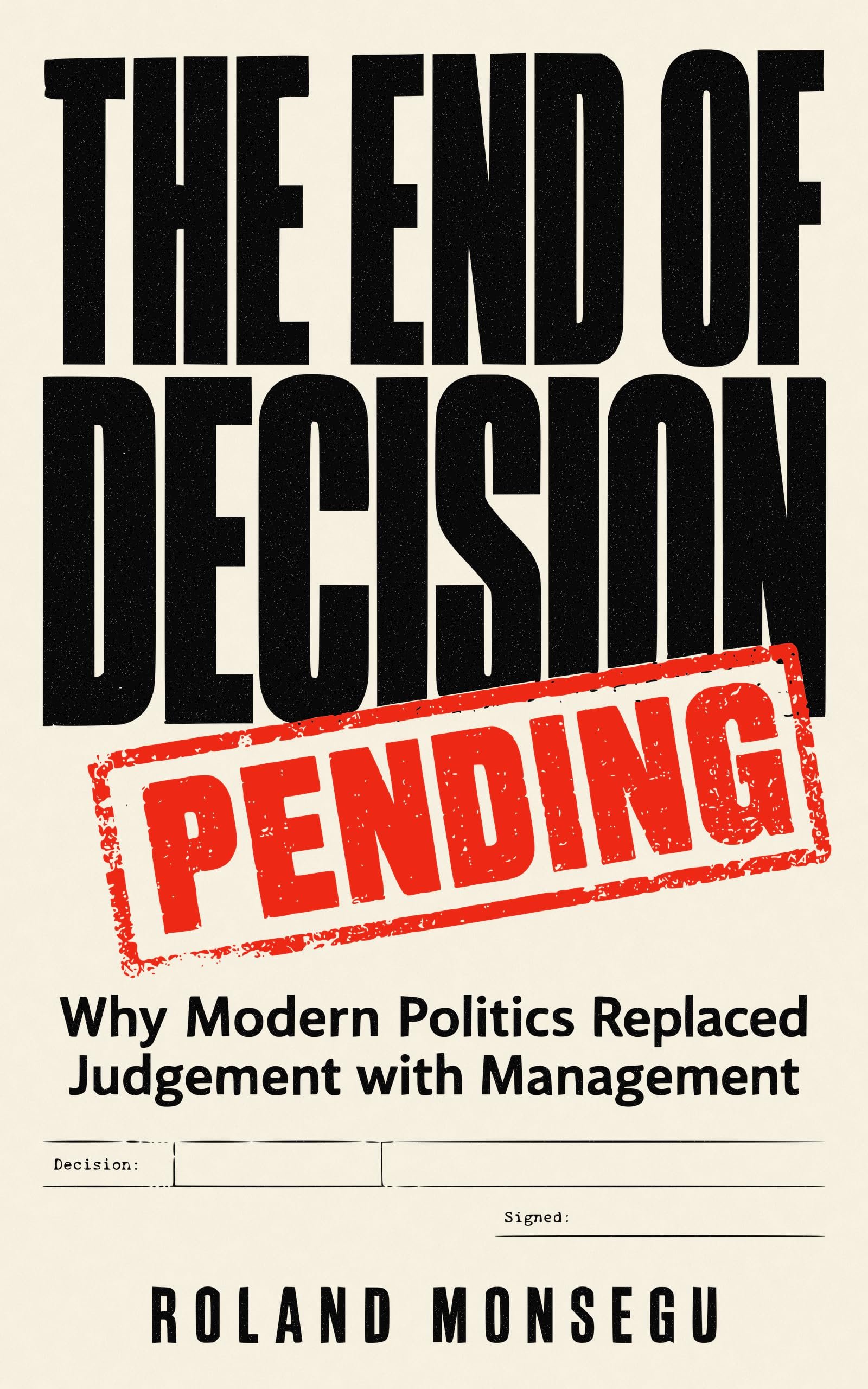
Free extract · The End of Decision
A World Full of Rules
The opening of The End of Decision, by Roland Monsegu
Modern politics isn’t failing because of ideology or bad faith, but because decision-making has been replaced by management and responsibility has quietly disappeared.
We live in a world that is rich in rules and poor in decisions.
There are procedures for almost everything. Forms to complete. Guidelines to follow. Protocols to respect. Impact assessments, compliance checks, consultations, and reviews. In many areas of life, it is no longer possible to act without first demonstrating that the correct process has been observed.
This is often presented as progress. Rules, we are told, protect us from the abuse of power. Procedures make outcomes fairer. Systems reduce error. They replace personal judgement with neutral standards and ensure that power is exercised safely.
And yet, despite the density of these systems, something feels wrong.
Major problems persist without resolution. Institutions appear busy but ineffective. Crises are declared, managed, relabelled and dragged out. Responsibility is hard to locate. When outcomes are poor, explanations are plentiful, but decisions are strangely absent.
It is not that nothing is happening. On the contrary, activity is everywhere. What is missing is something more basic: someone clearly deciding, and standing behind the consequences.
The disappearance of the decision
In earlier political systems, decisions were often more visible. Someone chose a course of action. That choice could be criticised, reversed, or punished. Success and failure were attached, however imperfectly, to identifiable authority.
Today, many outcomes no longer arise from decisions in this sense. They emerge from processes.
A policy is not chosen so much as produced. A regulation is not decided so much as generated. Responsibility is distributed across committees, agencies, consultants, and frameworks. Each part follows the rules. No single part owns the result.
This is not accidental. It is the point.
Modern systems are designed to minimise risk and avoid blame. Decisions are dangerous because they expose judgement. Judgement can be wrong. When it is wrong, someone can be held responsible. Processes, by contrast, are safe. If the procedure was followed, failure can be explained without anyone having to answer for it.
Over time, this logic reshapes institutions. Authority becomes something to manage rather than exercise. Leadership becomes something to perform rather than something to do. The safest action is not the one most likely to work, but the one most defensible after the fact.
Take one road.
The Dartford Crossing, east of London, has long been described by the people who run it as a severe pinch-point on the country’s roads. A second crossing, with a new road and a tunnel under the River Thames, has been planned for years. Serious work on it began in 2009.
Sixteen years later, in March 2025, the project finally received permission to go ahead. By then, its planning application had grown to around 359,000 pages, the longest in British history. Close to £300 million had been spent on the application process alone, according to the roads agency’s own figures. Not a spade had gone into the ground, and how the road would be paid for was still being worked out.
The first preparatory work, with archaeologists digging and site compounds going up, finally began in March 2026. The tunnelling itself is not due to start until 2028.
No one decided to delay this road for sixteen years. No one refused it. Every step was lawful, and every page was required by someone.
Think of a mille-feuille: layer upon layer of pastry, each one thin on its own, together impossible to cut cleanly. That is what decision-making has become.
We will come back to this road.
When procedure replaces judgement
Judgement is uncomfortable. It requires acting under uncertainty. It accepts trade-offs. It cannot guarantee correctness in advance. That is precisely why it is essential to politics.
Procedures promise something judgement cannot: the appearance of certainty. If the rules are followed, the outcome can be defended regardless of whether it works. This is deeply attractive in complex societies, where consequences are unpredictable and scrutiny is constant.
The result is a quiet shift. Decisions are broken down into steps. Steps are allocated to roles. Roles are monitored by metrics. Metrics are reviewed by oversight bodies. At each stage, responsibility becomes thinner.
Nothing in this system is irrational. Each part makes sense in isolation. Together, they produce something new: a form of governance that functions without judgement.
When outcomes disappoint, the response is rarely to reconsider the underlying choice. Instead, the process is refined. New safeguards are added. Additional layers of oversight are introduced. The system grows more elaborate, not more decisive.
This creates a paradox. The more complex the system becomes, the harder it is to act. The more rules there are, the less anyone decides.
The illusion of control
From the outside, systems that run on procedure look under control. They generate reports. They collect data. They produce language that sounds precise and responsible. This creates an impression of competence.
But control is not the same as authority.
Authority involves taking responsibility for a direction and accepting the risk that comes with it. Control involves ensuring that no individual bears that risk. In modern politics, control has steadily displaced authority.
This is why institutions can appear powerful while being ineffective. They regulate extensively, intervene frequently, and communicate constantly, yet struggle to change outcomes. Power is exercised, but ownership is missing.
The system does not fail dramatically. It fails quietly, through delay, drift and the slow build-up of rules. Problems are acknowledged, described, and described again. Each step follows the rules. The result is continuity without resolution.
Why this feels unreal
For citizens, this produces a strange experience.
Policies are announced, but their effects are unclear. Mistakes are admitted, but no one seems responsible. Elections change personnel, but not direction. Language becomes more moral, more technical or more soothing, while real decisions retreat into process.
This creates a sense that politics is no longer anchored in reality. Not because facts are ignored, but because outcomes no longer matter in the way they should. What matters is whether the system can justify itself.
When systems care more about justifying themselves than about results, they begin to drift. They follow their own internal rules rather than what happens in the real world. Reality becomes something to be managed, not confronted.
No one intends this drift. It emerges naturally from systems designed to protect themselves from error and blame. But it has a cost. Over time, the gap between what institutions say and what people experience widens.
Trust erodes, not because people are irrational, but because they sense that decisions are no longer being made in a meaningful way.
Not an ideological story
It is tempting to explain this in ideological terms. To blame a political movement, an economic model, or a cultural shift. Those explanations are comforting because they offer enemies and solutions.
But this is not primarily an ideological story.
The same pattern appears across different political traditions, policy areas, and countries. Left and right, public and private, national and international institutions all behave in similar ways once they come to run on procedure.
The problem is not belief, but design.
When systems are built to eliminate judgement, they succeed at doing so. When responsibility is distributed widely enough, it effectively disappears. When authority is treated as a risk rather than a necessity, management fills the gap.
The result is a politics that continues to operate, but no longer decides.
That does not mean this book takes no side. By the end, it will argue for a direction: fewer layers between a decision and the person who makes it, and leaders who are free to act but easy to remove. But that argument is about how power is organised, not about which values should win. It is open to anyone, whatever they believe.
A question worth asking
This book begins with a simple question, one that is rarely asked clearly:
Who is allowed to decide — and what happens if they are wrong?
Many contemporary systems struggle to answer it. They replace it with other questions: Was the process followed? Were the guidelines respected? Were the correct stakeholders consulted?
These questions matter, but they are not enough. Without decision, judgement, and responsibility, politics becomes an elaborate way of avoiding its own purpose.
The chapters that follow will examine how this happened, why it feels increasingly unreal, why many well-intentioned attempts to fix it make the problem worse, and what a working alternative would need.
But first, it is necessary to see the world as it is: full of rules, rich in process, and strangely empty of decision.
That was the opening of The End of Decision. The book continues with 23 chapters on how this happened, why the usual escapes make it worse, and what a working alternative would need.
Know someone who should read this? Share on LinkedIn · Send by email
Follow Roland on LinkedIn for new writing and updates.
Lisez-vous en français ? Lire l’ouverture de Circulez, il n’y a rien à décider →
© 2026 Roland Monsegu. All rights reserved. Please share a link to this page rather than copying the text.